Install Deb Packages Opensuse
In this tutorial we will learn how to install local software packages (.DEB) in Debian and its derivatives such as Ubuntu and Linux Mint using three different command line tools and they are dpkg, apt and gdebi.
This is useful to those new users who have migrated from Windows to Ubuntu or Linux Mint. The very basic problem they face is installing local software on system.
OpenSUSE is.rpm based. As for every distro, picking random packages from unknown sources (rpm in our case) and installing them can work or not, but surely increases widely the risk of breakage and undermines system security. OpenSUSE relies for its development on the openSUSE Build Service (OBS. And, if it is not in the openSUSE repo, it is better to get the source and compile it yourself than to use alien and deb. Imo, the best options in order are:-use YaST/Zypper to install from an openSUSE repo-use YaST/Zypper to install from a community repo-search at Software.openSUSE.org and-download rpm file and use YaST to install it.
However, Ubuntu and Linux Mint has its own Graphical Software Center for easy software installation, but we will be looking forward to installing packages through terminal way.
1. Install Software Using Dpkg Command
Dpkg is a package manager for Debian and its derivatives such as Ubuntu and Linux Mint. It is used to install, build, remove and manage .deb packages. but unlike other Linux package management systems, it cannot automatically download and install packages with their dependencies.
To install a local package, use the dpkg command with the -i flag along with package name as shown.
If you get any dependency errors while installing or after installing and launching a program, you can use the following apt command to resolve and install dependencies using the -f flag, which tells the program to fix broken dependencies.
To remove a package use -r option or if you want to remove all its files including configuration files, you can purge it using the --purge option as shown.
Remove Package in Ubuntu
To know more about installed packages, read our article that shows how to list all files installed from a .deb package.
2. Install Software Using Apt Command
The apt command is a advanced command-line tool, which offers new software package installation, existing software package upgradation, updating of the package list index, and even upgrading the whole Ubuntu or Linux Mint system.
It also offers apt-get and apt-cache command-line tools for managing packages more interactively on Debian and its derivatives such as Ubuntu and Linux Mint systems.
Essentially, apt-get or apt do not understand .deb files, they are designed to primarily handle package names (for example teamviewer, apache2, mariadb etc.) and they retrieve and install .deb archives associated with a package name, from a source specified in the /etc/apt/sources.list file.
The only trick to installing a local Debian package using apt-get or apt is by specifying a local relative or absolute path (./ if in current dir) to the package, otherwise it will try to retrieve the package from remote sources and the operation will fail.
Install Local Package Using apt-get in Ubuntu
To remove a package use remove option or if you want to remove all its files including configuration files, you can purge it using the purge option as shown.
3. Install Software Using Gdebi Command
gdebi is a tiny command-line tool for installing local deb packages. It resolves and installs package dependencies on the fly. To install a package, use the following command.

To remove a package installed from gdebi, you can use apt, apt-get or dpkg commands using purge option as shown.
That’s It! In this tutorial, we have explained three different command line tools for installing or removing local Debian packages in Ubuntu and Linux Mint.
If you know any other way of installing local packages, do share with us using our comment section below.
I have a deb package for installation.
Shall I install by dpkg -i my.deb, or by apt?
Will both handle the software dependency problem well?
If by apt, how can I install from the deb by apt?
g_p8 Answers
When you use apt to install a package, under the hood it uses dpkg. When you install a package using apt, it first creates a list of all the dependencies and downloads it from the repository.
Once the download is finished it calls dpkg to install all those files, satisfying all the dependencies.
So if you have a .deb file:
You can install it using:
You can install it using
sudo apt install ./name.deb(orsudo apt install /path/to/package/name.deb).With old
apt-getversions you must first move your deb file to/var/cache/apt/archives/directory. For both, after executing this command, it will automatically download its dependencies.Install
gdebiand open your .deb file using it (Right-click ->Open with). It will install your .deb package with all its dependencies.(Note: APT maintains the package index which is a database of available packages available in repo defined in
/etc/apt/sources.listfile and in the/etc/apt/sources.list.ddirectory. All these methods will fail to satisfy the software dependency if the dependencies required by the deb is not present in the package index.)
Why use sudo apt-get install -f after sudo dpkg -i /path/to/deb/file (mentioned in first method)?
From man apt-get:
When dpkg installs a package and a package dependency is not satisfied, it leaves the package in an 'unconfigured' state and that package is considered broken.
sudo apt-get install -f command tries to fix this broken package by installing the missing dependency.
Install your foo.deb file with dpkg -i foo.deb. If there are some errors with unresolved dependencies, run apt-get install -f afterwards.
Here's the best way to install a .deb file on Ubuntu on the command-line:
Suse Linux Install Package
If you don't have gdebi installed already, install it using sudo apt install gdebi-core.
gdebi will look for all the dependencies of the .deb file, and will install them before attempting to install the .deb file. I find this much preferable than sudo dpkg -i skype.deb && sudo apt install -f. The latter is much too eager to remove dependencies in certain situations. For instance, when I tried to install Skype, it attempted to remove 96 (!) packages, including packages like compiz and unity! gdebi gave a much clearer error message:
(Here is the solution to that particular issue, by the way.)
You can install a local .deb package by:
Make sure to specify a local relative or absolute path (./ if in current dir), otherwise it will look for foo.deb in the remote repos and fail.
Install Deb Packages Opensuse 10
Check the dependencies with dpkg -I my.deb and apt-get install the dependencies before dpkg -i my.deb.
May be you can copy the Doesn't work, my.deb in /var/cache/apt/archives and install it directly with apt-get but I never tried.apt-get and dpkg are looking for packages listed in archives.
Opensuse Install Packages
The simplest answer would be to use dpkg by running dpkg -i packagename.deb. You could then uninstall it by running dpkg -r packagename.deb.apt-get is a higher level installer based off of dpkg, and as such you could apt-get install packagename.deb.
It would be beneficial for add it to your apt-get archives directory (/var/cache/apt/archives) so you could reference it as a package with dependencies and not a standalone .deb archive.
Also, by adding it to your apt-get archives directory, you have the opportunity to use dependencies with apt-get install packagename. This would let you install it with any manually added dependencies instead of dpkg's standalone archive-based system.
Modern apt-get can be used to install a package simply with apt-get install /path/to/package/name.deb.
(should be done as edit to the top answer but it was rejected - see https://unix.stackexchange.com/posts/159114/edit)
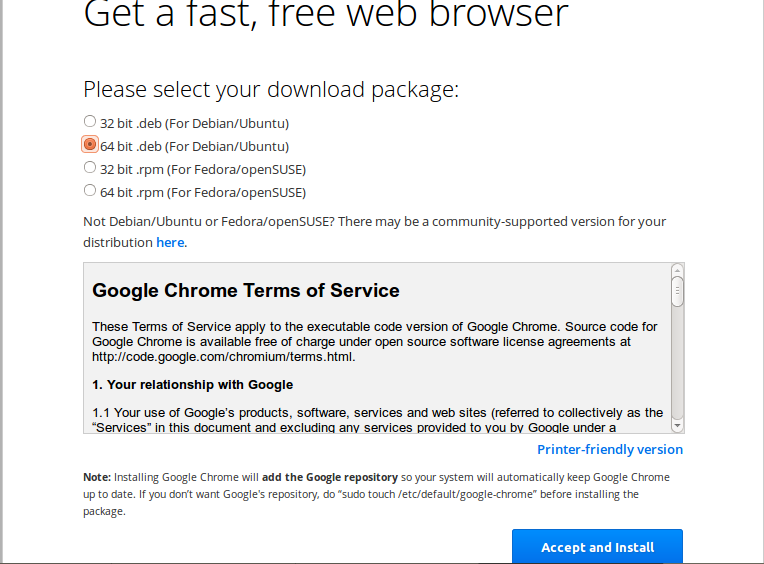
It is very simple if I want to install Chrome. Dsl-502t software download.
Install your Chrome file as:
Sometimes there is a chance of getting some dependency errors like the following:
So to resolve above issues, you need to add dependencies; give the following command:
After giving the above command, dependencies will be added to your machine and your Debian package (.deb) file will be installed.
protected by Community♦Nov 6 '15 at 13:57
Thank you for your interest in this question. Because it has attracted low-quality or spam answers that had to be removed, posting an answer now requires 10 reputation on this site (the association bonus does not count).
Would you like to answer one of these unanswered questions instead?